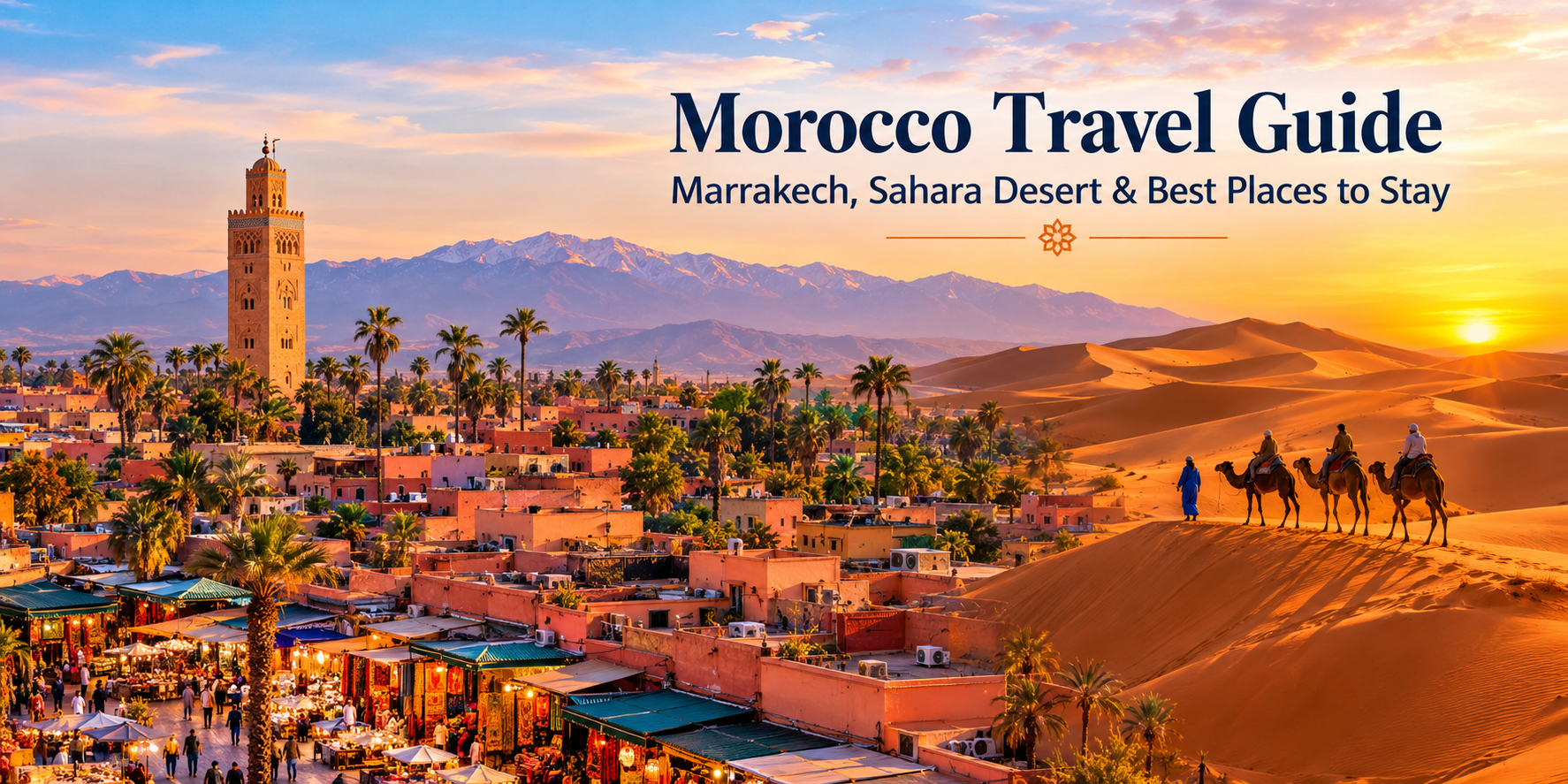
Why Visit Morocco?
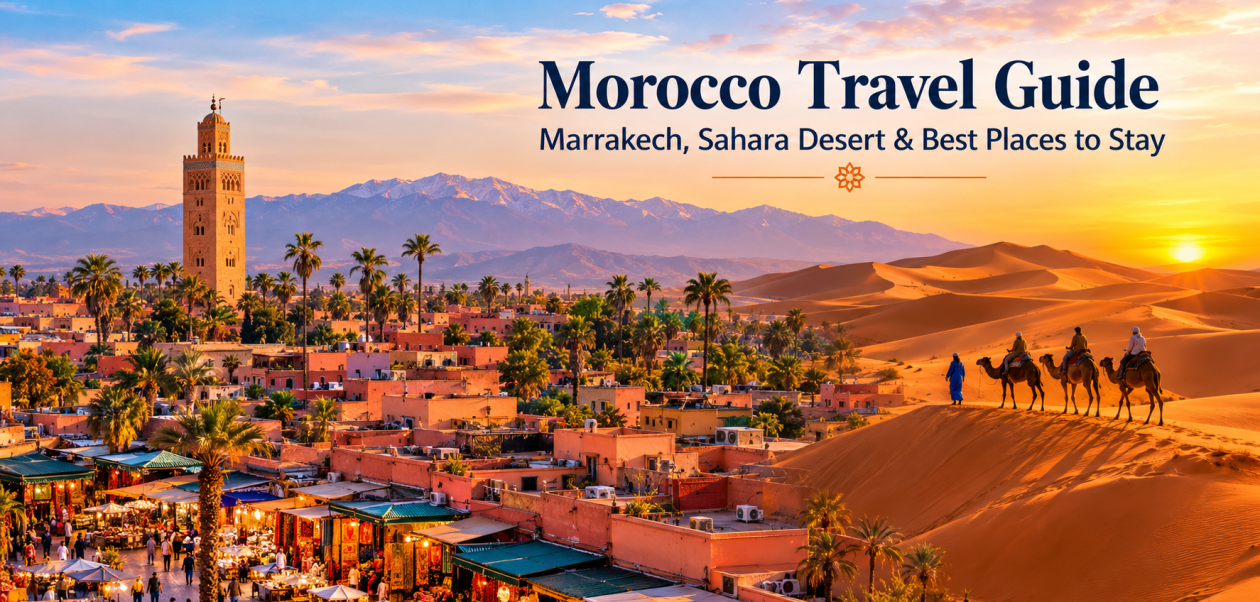
Morocco’s appeal comes from its variety.
Within one trip, travelers can experience:
- Medieval-style medinas
- Colorful souks
- Berber/Amazigh culture
- Atlantic beaches
- High Atlas mountain scenery
- Ancient kasbahs
- Palm-filled oases
- Sahara dunes
- Traditional hammams
- Moroccan cuisine
- Luxury riads and desert camps
The country is particularly rewarding for travelers who enjoy slow exploration rather than checking off attractions.
A morning in Marrakech might mean mint tea on a rooftop, followed by an afternoon in the souks and an evening around Jemaa el-Fna. A few days later, you could be watching the sunrise over the dunes near Merzouga.
Marrakech: The Best Starting Point for First-Time Visitors
Marrakech is often called the Red City because of the distinctive ochre tones of its historic architecture.
The city divides naturally into two very different experiences: the historic Medina and newer districts such as Gueliz and Hivernage. The official tourism board describes the Medina, Jemaa el-Fna, Majorelle Garden and Koutoubia Mosque among Marrakech’s key attractions. Visit Morocco
Best areas to stay in Marrakech
Medina: Best for atmosphere, riads, souks and walking to historic sights.
Kasbah: A quieter part of the old city with good access to monuments and traditional accommodation.
Gueliz: Better suited to travelers who prefer modern restaurants, cafés, shops and wider streets.
Hivernage: Ideal for luxury hotels, resort-style stays and nightlife.
Quick tip
For a first Marrakech visit, staying in a traditional riad in or near the Medina can make the destination feel much more immersive. A riad is a traditional Moroccan house organized around an interior courtyard or garden. Visit Morocco
Best Things to Do in Marrakech
1. Explore Jemaa el-Fna
Jemaa el-Fna is Marrakech’s famous central square and one of the city’s defining experiences.
Visit during the day to explore surrounding souks and cafés, then return in the evening when the atmosphere changes dramatically.
Go with an open mind, but keep your belongings secure and agree on prices before accepting services or taking part in paid activities.
2. Get Lost in the Souks
The souks are a major reason to visit Marrakech.
You’ll find:
- Leather goods
- Ceramics
- Lanterns
- Rugs
- Spices
- Babouche slippers
- Textiles
- Metalwork
- Traditional crafts
Bargaining is part of the shopping culture, but it should remain friendly. If you are not genuinely interested in an item, don’t start a negotiation simply for entertainment.
3. Visit Jardin Majorelle
The Majorelle Garden is one of Marrakech’s best-known attractions and a natural break from the intensity of the Medina.
Consider visiting early in the day, especially during busier travel periods.
4. See the Koutoubia Mosque
The Koutoubia’s minaret is one of Marrakech’s most recognizable landmarks.
Non-Muslim visitors generally admire the exterior and surrounding gardens rather than entering the mosque.
5. Explore the Bahia Palace
Bahia Palace offers a glimpse into Moroccan architecture through courtyards, tilework, carved wood and decorative plasterwork.
It pairs naturally with a Medina walking tour.
6. Visit the Saadian Tombs
The Saadian Tombs provide another window into Marrakech’s dynastic history and are particularly worthwhile for architecture enthusiasts.
7. Experience a Moroccan Hammam
A traditional hammam can be one of the most memorable cultural experiences in Morocco.
For a first visit, choose a reputable hammam or hotel spa and understand what the treatment includes before booking.
Marrakech Desert Tours: What You Need to Know
One of the biggest planning mistakes first-time visitors make is assuming that Marrakech is next to the Sahara.
It isn’t.
The famous golden dunes around Merzouga and Erg Chebbi are a long journey from Marrakech. The Moroccan tourism board’s suggested desert route connects Marrakech with Ouarzazate/Zagora/Tinghir and then the Errachidia–Midelt–Merzouga region. Visit Morocco
That distance is important when choosing a tour.
Marrakech to Merzouga: The Classic Route
A typical overland itinerary may travel through:
Marrakech → High Atlas Mountains → Aït Benhaddou → Ouarzazate → Dades Valley → Todra Gorge → Erfoud → Merzouga
This is more than a transfer. The route itself is part of the experience.
Highlights along the way
- High Atlas scenery
- Tizi n’Tichka mountain route
- Aït Benhaddou
- Ouarzazate
- Dades Valley
- Todra Gorge
- Palm oases
- Rissani
- Erg Chebbi dunes
- Desert camp
Aït Benhaddou, in particular, is worth building into the itinerary rather than treating it as a quick roadside photo stop.
Which Morocco Desert Tour Should You Choose?
| Tour Type | Best For | Typical Length |
| Agafay Desert | Short trips from Marrakech | Half/full day |
| Zagora | Travelers with limited time | 2 days/1 night |
| Merzouga | First-time Sahara experience | 3–4 days |
| Private Merzouga tour | Couples, families, comfort | 3–5 days |
| Luxury desert camp | Special occasions | 3–5 days |
Agafay vs Sahara
This distinction matters.
Agafay Desert is close to Marrakech and offers a desert-like rocky landscape, making it convenient for a short excursion.
Merzouga, by contrast, gives you the classic expansive sand-dune experience associated with the Sahara.
If seeing large golden dunes is one of your Morocco bucket-list experiences, prioritize Merzouga rather than choosing a short Agafay excursion simply because it is closer.
The official tourism board specifically promotes Merzouga for dune experiences, camel excursions and overnight desert camps. Visit Morocco
What Is a Sahara Desert Camp Like?
A typical desert experience may include:
- Arrival near the dunes
- Camel ride or 4×4 transfer
- Sunset over the dunes
- Arrival at a desert camp
- Moroccan dinner
- Traditional music
- Stargazing
- Overnight stay
- Sunrise
- Breakfast
- Departure by camel or vehicle
Luxury camps can offer private tents, proper beds, electricity, private bathrooms and more elaborate dining.
Budget camps tend to be much simpler.
My recommendation
If you’re traveling all the way to Merzouga, spend at least one night in the desert.
The most memorable part isn’t necessarily the camel ride. It’s the silence, sunset, darkness and sunrise.
Best Time to Visit Morocco
Morocco can be visited throughout the year, but the ideal season depends on your itinerary.
Spring: March to May
One of the best periods for a first trip.
Expect pleasant conditions for:
- Marrakech sightseeing
- Atlas Mountain excursions
- Road trips
- Desert tours
Summer: June to August
Summer can be extremely hot in Marrakech and desert regions.
It can still work if you plan around the heat, but travelers should expect very high daytime temperatures in southern Morocco.
Autumn: September to November
Another excellent period for touring Morocco.
September can remain hot, while October and November are generally more comfortable for sightseeing.
Winter: December to February
Marrakech can be pleasantly mild during the day, but nights can be cold.
The desert is also much colder after sunset than many first-time visitors expect.
Best overall choice
April–May and October–November are excellent choices for a Marrakech + Sahara itinerary.
Where to Stay in Marrakech
Accommodation can dramatically change your Marrakech experience.
Luxury:
Royal Mansour Marrakech4.6Hotel
For travelers seeking an exceptional luxury experience, Royal Mansour is one of Marrakech’s standout properties.
Rather than conventional hotel rooms, the property has 53 private riads, combining traditional Moroccan craftsmanship with high-end hospitality. In September 2026, it was ranked 26th in The World’s 50 Best Hotels and named Best Hotel in Africa. Royal Mansour
Best for: Honeymoons, milestone trips, luxury travelers and travelers who want the hotel itself to be part of the experience.
Mid-Range: Choose a Well-Rated
For most travelers, a highly rated independent riad is the sweet spot.
Look for properties with:
- Strong recent guest reviews
- Air conditioning
- Good location
- Airport transfer options
- Breakfast included
- Clear directions to the property
- 24-hour reception or arrival assistance
Best for: Couples and first-time visitors who want traditional architecture without palace-level prices.
Budget: Medina Hostels and Simple Riads
Budget travelers can find hostels and simple riads around the Medina, with prices varying considerably by season and location.
Don’t choose solely by the lowest nightly rate. A slightly more expensive property with good reviews, a convenient location and reliable staff can save considerable hassle.
Best for: Backpackers, solo travelers and travelers spending more of their budget on excursions.
Other Places Worth Adding to a Morocco Itinerary
Marrakech is only one part of Morocco.
Essaouira
Essaouira
A laid-back Atlantic coastal city known for its historic medina, seafood, harbor and breezy atmosphere.
It’s an excellent contrast to busy Marrakech.
Fez
Fez
Choose Fez if medieval architecture, traditional crafts and historic urban culture are high on your list.
Chefchaouen
Chefchaouen
The famous blue-painted mountain town makes an excellent addition to a northern Morocco itinerary.
Casablanca
Casablanca
More modern and business-oriented than Marrakech or Fez, Casablanca is particularly useful as an international arrival or departure point.
Atlas Mountains
The mountains around Marrakech provide an easy escape from the city, with hiking, villages, valleys and dramatic scenery. The tourism board highlights the nearby Atlas Mountains and Toubkal National Park as major outdoor attractions. Visit Morocco
Suggested 7-Day Morocco Itinerary
Day 1 — Arrive in Marrakech
- Check into your riad
- Explore the surrounding Medina
- Sunset rooftop dinner
- Jemaa el-Fna in the evening
Day 2 — Marrakech
- Bahia Palace
- Souks
- Koutoubia Mosque
- Jardin Majorelle
- Moroccan dinner
Day 3 — Marrakech to Dades Valley
Begin your desert journey.
- Cross the Atlas Mountains
- Visit Aït Benhaddou
- Continue toward Ouarzazate
- Overnight in the Dades Valley
Day 4 — Dades Valley to Merzouga
- Dades Valley
- Todra Gorge
- Erfoud/Rissani region
- Arrive in Merzouga
- Camel ride
- Sunset
- Desert camp
Day 5 — Merzouga to Ouarzazate area
- Sunrise in the desert
- Breakfast
- Return journey
- Overnight around Ouarzazate
Day 6 — Return to Marrakech
- Scenic drive through the Atlas region
- Afternoon in Marrakech
- Hammam or spa
Day 7 — Marrakech
Keep your final day flexible for:
- Shopping
- Food experiences
- Museums
- Gardens
- Relaxing at your riad
- Departure
Better option for a relaxed trip
If you have 9–10 days, don’t simply add more attractions.
Instead, give Marrakech two or three full days, spend three or four days on the desert route, and add Essaouira or an Atlas Mountains stay.
Estimated Morocco Travel Budget
Costs vary substantially according to season, accommodation and whether you choose a private or group desert tour.
As a rough planning framework:
| Travel Style | Approx. Daily Budget* | Suitable For |
| Budget | 320–680 MAD | Hostels, simple riads, inexpensive meals |
| Mid-range | 760–1,420 MAD | Comfortable riads, restaurants, activities |
| Comfort/Luxury | 1,900–3,800+ MAD | Upscale hotels, private transfers and premium experiences |
*Approximate on-the-ground Marrakech planning figures; flights, major shopping and premium multi-day desert tours can add substantially to the total. Recent 2026 Marrakech pricing data shows how widely costs can vary between budget and luxury travel. Marrakech Authority
Where your money goes
Accommodation: Biggest variable.
Food: Morocco can be inexpensive if you eat locally, but upscale restaurants and hotel dining can become expensive quickly.
Transport: Trains and buses are useful between major cities; private transfers become more relevant for desert routes.
Tours: A private Sahara itinerary can cost considerably more than a shared group tour.
Moroccan Food to Try
Don’t leave Morocco without trying:
Tagine
Slow-cooked meat or vegetables prepared in the distinctive conical cooking vessel.
Couscous
A Moroccan staple traditionally associated with family meals and communal dining.
Tanjia
Particularly associated with Marrakech, this slow-cooked meat dish is traditionally prepared in an earthenware vessel.
Pastilla
A sweet-and-savory pastry traditionally made with layers of pastry and seasoned filling.
Harira
A hearty soup often made with tomatoes, legumes and herbs.
Mint Tea
Moroccan mint tea is more than a drink—it is an important part of hospitality.
Street food
Food markets and casual restaurants can offer excellent value, but choose busy establishments with high turnover and good hygiene practices.
Getting Around Morocco
Trains
Trains are useful for major city connections.
For example, rail travel works well when connecting cities such as Marrakech, Casablanca, Rabat, Fez and Tangier.
Buses
Long-distance buses can reach destinations not directly served by rail.
Taxis
Marrakech uses different taxi arrangements, and prices should be clarified before traveling if the fare isn’t metered or clearly established.
Private Transfers
For desert trips, private transport can make a major difference.
If your itinerary involves multiple stops, a private driver allows you to travel at your own pace and stop at viewpoints, villages and attractions.
Car rental
A rental car can be useful for confident drivers planning an independent road trip.
For a first visit focused on Marrakech and the Sahara, however, a combination of trains, transfers and organized tours is often less stressful.
How to Get to Marrakech
Marrakech-Menara Airport is the principal international gateway for the city.
Morocco has multiple international airports, and Marrakech is one of the country’s major tourism gateways. Visit Morocco
For your arrival:
- Arrange airport transport in advance if staying in the Medina.
- Confirm whether your riad can be reached by vehicle.
- Keep the property’s phone number accessible.
- Don’t assume a taxi can drop you directly at the door of a riad inside pedestrian streets.
That final point is especially important. Medina accommodation can involve a short walk from the nearest vehicle-accessible street.
Morocco Travel Essentials
Currency
Moroccan dirham (MAD/DH).
Carry some cash, particularly for souks, small restaurants, taxis and rural areas. Cards are accepted more widely in larger hotels and businesses. Visit Morocco
Language
Arabic and Amazigh are official languages. French is widely spoken, particularly in tourism and business. Visit Morocco
Power Plugs
Morocco generally uses Type C and Type E electrical sockets with a 220–240V supply.
Bring a universal travel adapter if your devices use another plug type.
SIM/eSIM
An eSIM can be convenient if your phone supports it.
Alternatively, local SIM cards are widely available. Compare data allowances and network coverage before buying.
For a desert road trip, download offline maps before leaving Marrakech.
Visa Requirements
Visa requirements depend on nationality.
Morocco’s official tourism guidance states that eligible travelers can use the Accès Maroc portal for electronic visa or electronic travel authorization applications where applicable. Tourist stays are generally limited to 90 days. Always verify the rules for your passport before booking a non-refundable trip. Visit Morocco
Emergency Numbers
Official travel sources list:
- Police: 190
- Ambulance: 150
- Gendarmerie: 177
Save your country’s embassy or consulate number before departure as well. GOV.UK
Morocco Safety Tips
Morocco is an established tourism destination, but normal precautions still matter.
Keep valuables secure
Pickpocketing can occur in busy markets and tourist areas.
Be cautious with unsolicited help
Some people may offer directions or assistance and then expect payment.
Agree on taxi fares
Clarify the fare before setting off when appropriate.
Respect local customs
Morocco is a predominantly Muslim country. Dress modestly when visiting religious or conservative areas, and be particularly respectful during Ramadan.
Protect yourself from the sun
This is particularly important on desert excursions and mountain hikes.
Choose reputable desert operators
Before booking, check:
- Recent reviews
- What’s included
- Accommodation standard
- Vehicle type
- Group size
- Meals
- Insurance arrangements
- Cancellation policy
- Whether the itinerary is genuinely private
Packing List for Morocco
For a Marrakech + Sahara trip, pack:
- Comfortable walking shoes
- Lightweight breathable clothing
- Light jacket
- Warm layer for desert nights
- Sunglasses
- Sunscreen
- Reusable water bottle
- Universal adapter
- Power bank
- Small daypack
- Scarf or shawl
- Basic medication
- Offline maps
- Travel insurance documents
Desert-specific tip
Don’t underestimate nighttime temperatures.
Even after a very warm desert afternoon, the temperature can drop substantially after sunset. A warm layer is worth the space in your luggage.
Sustainable Travel in Morocco
A few simple choices can make your trip more responsible:
- Stay in locally owned riads when possible.
- Buy directly from artisans.
- Avoid buying products made from threatened wildlife or questionable materials.
- Carry a reusable bottle.
- Don’t leave waste in desert or mountain areas.
- Use licensed local guides.
- Choose smaller-group experiences where practical.
- Respect villages and ask before photographing people.
Morocco’s tourism authorities actively promote eco-responsible tourism and sustainable travel experiences. Visit Morocco
Pros and Cons of a Marrakech + Sahara Trip
Pros
- Extraordinary cultural variety
- Excellent food
- Beautiful architecture
- Memorable desert landscapes
- Wide range of accommodation
- Strong choice for couples and families
- Good opportunities for photography
- Easy to combine cities, mountains and desert
Cons
- Marrakech can feel intense and crowded
- Sahara excursions involve long driving days
- Summer heat can be extreme
- Desert temperatures vary considerably
- Tourist areas require some vigilance against scams
- Short itineraries can become rushed
Who Is Morocco Best For?
Couples: Excellent for romantic riads, rooftop dinners and desert camps.
Families: Marrakech, Atlas Mountain excursions and carefully selected desert tours can work well, but consider travel times and children’s tolerance for long drives.
Solo travelers: Morocco offers plenty of organized experiences and social accommodation, although navigating busy Medinas can take some adjustment.
Luxury travelers: Marrakech has an impressive selection of luxury riads, palaces and resorts, while luxury desert camps can turn a road trip into a high-end experience.
Adventure travelers: Combine the Atlas Mountains, desert, hiking and road travel.
First-time Africa travelers: Morocco is a relatively accessible introduction to North Africa, especially when you build an itinerary around established tourist routes.
FAQ
Is Marrakech worth visiting?
Yes. Marrakech is one of Morocco’s best destinations for first-time visitors, particularly if you enjoy markets, architecture, food, culture and traditional accommodation.
How many days do you need in Marrakech?
Three days is a good starting point. Four days gives you more time for gardens, hammams, food experiences and a day trip.
How many days do I need for a Sahara desert tour?
Allow at least three days from Marrakech for a worthwhile Merzouga journey. Four days is better if you want to avoid spending almost the entire trip in the vehicle.
Is Agafay the real Sahara?
No. Agafay is a rocky desert landscape close to Marrakech. Merzouga provides the classic large sand dunes most travelers associate with the Sahara.
What is the best place to stay in Marrakech?
For atmosphere, choose a well-reviewed riad in the Medina. For modern comforts and nightlife, consider Hivernage or Gueliz. For an ultra-luxury experience, properties such as Royal Mansour are in a different category altogether.
Is Morocco expensive?
It depends on your travel style. Budget travelers can travel relatively affordably, while luxury hotels, private desert tours and high-end dining can make Morocco considerably more expensive.
Is Marrakech safe for tourists?
Marrakech is a major tourist destination, but travelers should use normal precautions, particularly around crowded markets and tourist attractions. Keep valuables secure and be cautious with unsolicited assistance.
Can I visit the Sahara from Marrakech as a day trip?
It is not practical to visit the Merzouga dunes as a day trip from Marrakech. The distance is too great. Choose a multi-day itinerary instead.
What should I wear in Morocco?
Light, breathable and respectful clothing is a good choice. Bring a layer for cooler evenings and more coverage when visiting religious or conservative areas.
Should I book a private or group desert tour?
Choose a private tour if flexibility, comfort and photography stops matter most. A shared tour can be substantially cheaper and works well for solo travelers and budget-conscious visitors.
Conclusion
Morocco is best experienced as a journey rather than a single destination.
Start in Marrakech for the souks, palaces, gardens, food and riads. Then travel south through the Atlas Mountains and historic kasbah country before reaching the dunes around Merzouga. If time allows, add Essaouira, Fez, Chefchaouen or an Atlas Mountain stay.
For accommodation, a traditional riad offers the most atmospheric Marrakech experience, while luxury travelers can choose from exceptional palace hotels. In the desert, spending at least one night in a well-reviewed camp is worth prioritizing.
The key is not to squeeze too much into too little time. Morocco’s landscapes and cultural experiences deserve room to breathe.